Celeste bandera: patriotism and play at the Cabildo
Artist Nora Iniesta presents the exhibition Celeste bandera at the Cabildo of Buenos Aires, a tour through recent works never shown before that revisits the imagery of the May Revolution. The show fills the museum's Democracia room and closes on Saturday, November 14.
Iniesta is known for working with the Argentine flag and the national colors. According to Clarín, she is among the most productive artists of her generation: she mounts several shows a year in different venues, always with work that had not been seen before. In 2026 she won the National Prize for Artistic Career, awarded at the 113th National Visual Arts Salon.
The project grew out of a cockade workshop the artist gave at the Cabildo during the 2025 Night of the Museums. From that experience, curator María Laura Pérez Veronesi, part of the museum's own team, where she works as a museum specialist, invited her to build an exhibition about childhood, play, school and a genuine patriotism, themes that run through her work.
Twelve pieces with colonial iconography
The Democracia room holds twelve pieces that combine colonial iconography with national symbols. Some are unseen and others are among the best known of her career. Clarín describes work understood through gesture and synthesis, with material as a mere vehicle for an idea, and defines Iniesta as an administrator of patriotic ready-mades: common symbols that build a shared feeling.
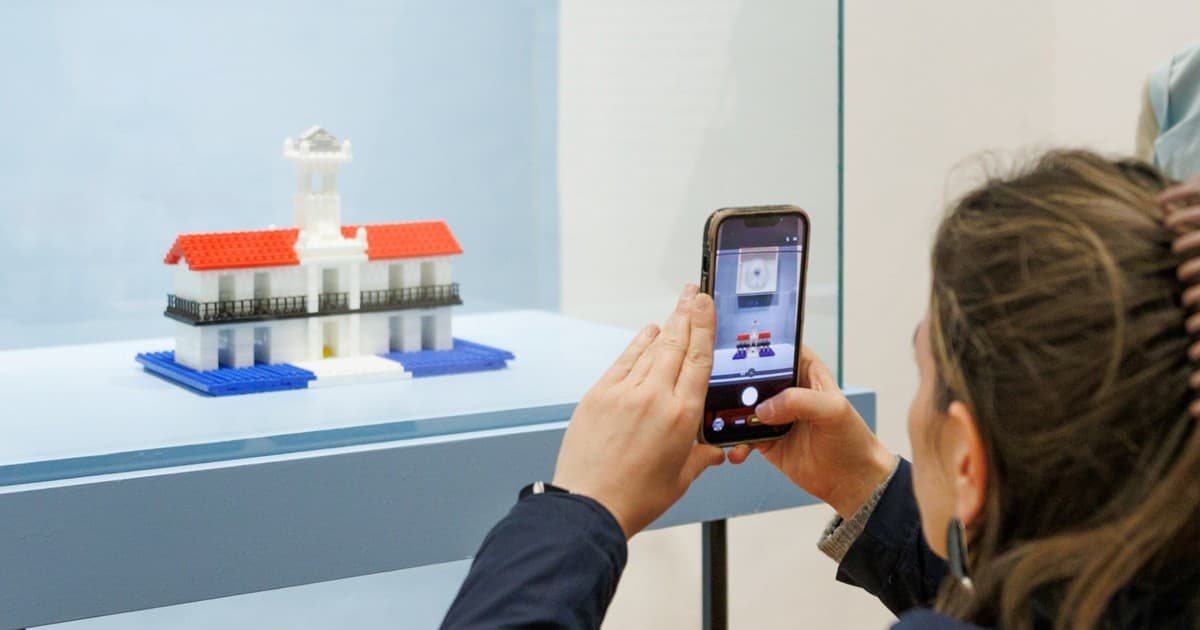
The exhibition is organized around two small altars to the homeland. The first holds a Cabildo built from toy bricks, lent by the Tedesco collection. The second shows a piece titled Desobediencia de vida: several school chairs arranged as if turning their backs on authority, except one that faces the wall.
On that wall is a collage that takes as its point of view a school sticker of the Cabildo, attached to a gilded cardboard tray. The detail points to school picture cards and childhood, ground the artist has worked for years.
Party goods, cockades and a humorous eye
On one side of the room hang party umbrellas that evoke imagined memories of May 25, 1810. Next to them are giant cockades embedded in transparent plastic aprons, conceived in recognition of the women who risked their bodies in the revolution.
The school imagery of the Viceroyalty also appears. In front of the figure of the broom seller, always framed in white and sky blue, Iniesta says she loves that iconography and jokes that she doubts a broom seller ever dressed like that.
Horacio Mosquera, who runs the Cabildo museum, describes sky blue and white as a bridge through which bonds and identity pass. According to Clarín, the everyday and party materials are there to recall the fragility of what is represented and the shared agreement through which a nation's narratives were forged. The paper adds an irony: the Cabildo that hosts the show also needed a collective pact to believe it is the original.
If you go
Celeste bandera can be visited at the Cabildo of Buenos Aires until November 14. The works are in the Democracia room, where twelve pieces, some unseen and some anthological, are on view. Opening hours and ticket price are not in the sources we read, so it is best to confirm them with the museum before going.
If you want to understand where the idea came from, keep in mind that it began with a cockade workshop during the 2025 Night of the Museums. The curator is María Laura Pérez Veronesi of the institutional team, and the museum is directed by Horacio Mosquera.
Source: Clarín
Stories worth sharing.